
Share this post
Find Your Perfect Pan!
know that hat type of pan do I need?
As an Everhot owner, you might be looking for a new set of pans that will help you make the most out of your cooker. Whilst most pans will be suitable for your cooker, there are a few things to keep in mind:
- When using a pan on the hotplate, the pan must have a flat base (it might be worth holding a straight-edged ruler to the bottom of the pan so you can make sure it is flat). This is because the more contact your pan has with the hotplate, the more heat can be transferred. This leads on to the next point…
- The bigger the base of your pan, the better! The larger the surface area of the base of your pan, the more contact the pan will have with the hotplate and therefore the quicker your pan will heat up.
- When using the induction, you must use magnetic pans. The induction works using an electromagnet, if your pan is not completely magnetic, the pan will not work, or it will damage the induction hob.
We have compiled a list of pros and cons for common types of pans that you might be considering using:
Stainless steel:

As a brand, we love stainless steel, some of the ovens in our cookers are stainless steel. This allows them to be turned off without ever rusting, this is perfect for the summer when you want to reduce the heat output of your cooker and save a bit of money on the electricity bill.
Anyway, back to pans…
Pros:
- Controllability – Stainless steel is a very conductive metal which means it heats quickly and distributes heat evenly, making it great for foods that need precise temperature control.
- Durability – Stainless steel is a very strong and durable metal, it will not warp over time or scratch easily. This means you can use metal utensils and abrasive cleaners.
- Stainless steel pans often have an encapsulated base which improves their efficiency and heat distribution.
- Easy maintenance – Stainless steel does not rust, meaning you do not have to worry too much about maintaining it. It can also go through a dishwasher with no issues.
Cons:
- ‘Stickiness’ – Stainless steel does not have the natural characteristic of non-stick. In order to achieve a ‘non-stick’ effect, the pan has to be very hot, and even then, it is not completely non-stick. This can make the cleaning of the pan slightly difficult (Thank goodness it can go through the dishwasher!)
- Price – Stainless steel price can unfortunately be on the pricier side (although, it is important to invest in good quality pans for your cooker).
Cast iron:

Cast iron pans are a classic type of pan that have been used for centuries. We love cast iron casserole dishes for slow cooking in our simmering ovens. They are heavy-duty and can last a lifetime, but they do need specific care.
Pros:
- Heat retention – Cast iron is a material that is great at retaining heat (we use cast iron in our cookers because of this amazing property) this means cast iron pans are fantastic for slow cooking.
- Durability – With proper maintenance, cast iron pans can last lifetimes.
- Naturally non-stick – Cast iron pans can be seasoned with oil, this creates a coating that is naturally non-stick, making the pans easier to cook with and clean.
- Versatility – due to the non-stick property of a seasoned cast iron pan, they are great for frying, slow cooking or even baking.
- Cast iron pans often have an enamel coating to improve their non-stick property, which also reduces the maintenance of the pan.
Cons:
- Maintenance – Cast iron pans are notoriously high maintenance. Cast iron pans must be seasoned to allow you to take advantage of their non-stick properties. This is easy enough, but to make sure you do not damage the seasoning, you must wash the pan with care. Using washing up liquid on the pan could remove some of the oils that create the non-stick effect. The dishwasher is a definite no! Cast iron is a material that is also susceptible to rust so it is important to look after these pans.
- Weight – Cast iron is a very heavy material. Although some people may not mind, it can be daunting to move large, hot, and heavy pans around your kitchen.
- Reactive to acidic foods – Cast iron can react with certain acidic foods, creating a metallic taste.
- Price – cast iron pans are expensive (they can however, last a lifetime so it is arguable that a good cast iron pan could save you money in the long run).
Non-stick:
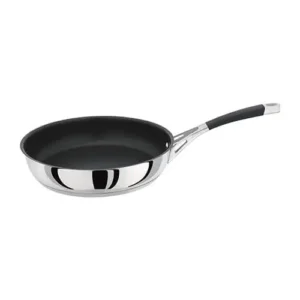
Non-stick pans have recently been under scrutiny due to the potential for them to be toxic if not used correctly. However, you can safely use non-stick, and they can be extremely useful in the kitchen for more delicate foods.
Pros:
- Non-stick – As it says in the name, these pans are non-stick! This means that they are perfect for cooking delicate foods that could be ruined by sticking. It also means cleaning is a lot easier because less food will be stuck to the pan. Non-stick pans also mean you can cook with less oil, which is perfect if you are trying to reduce fat in your meals.
Cons:
- Delicate coating – The non-stick coating on a pan is not particularly durable. Using high heat, metal utensils or even the dishwasher can damage the coating (Please read the the description of the pan you are buying to clarify maintenance details). It is also important to replace the pan when the coating is damaged as it can release toxins.
- Health concerns – Older style non-stick pans raised concerns due to the use of PFOA in the coating. Generally, non-stick pans now are PFOA free but there are still concerns about the use of chemicals used to make the non-stick coating.
Copper:
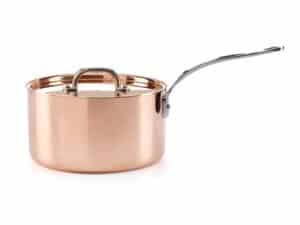
Copper pans are a beautiful and efficient type of pan but, can be difficult to source and expensive to buy. Did you know that copper is an extremely conductive metal, making it a popular choice when it comes to pans for professional chefs?
Pros:
- Controllability – Copper pans are extremely conductive, making them quick to heat up and their heat distribution very even. They are fantastic for foods that require precise temperature control.
Cons:
- Price – Good quality copper pans are very expensive, they are also hard to find!
- Maintenance – Copper pans require regular polishing to prevent tarnishing.
- Reactive to acidic food – Copper is another material that is reactive to acidic food. Copper pans are often lined with other metals to prevent contact.
Carbon Steel:

Carbon steel is an alloy of carbon and steel and has similar characteristics to a cast iron pan, however, these pans are a lot lighter making them a more favourable option for some.
Pros:
- Lightweight – carbon steel pans are lightweight compared to cast iron pans.
- Non-stick – Similarly to cast iron pans, carbon steel pans can be seasoned, creating a natural non-stick effect.
- Controllability – carbon steel pans are quick to heat up, allowing precise temperature control.
Cons:
- Maintenance – Carbon steel pans require seasoning to maintain their non-stick property. Carbon steel pans are also susceptible to rust if not maintained properly.
- Reactive to acidic foods – carbon steel reacts to acidic food. In some cases, this can damage the seasoning of the pan.
- Price – carbon steel pans are expensive.
Pans to avoid:
There are certain pans that we ask Everhot owners to avoid:
- ‘Spotty-bottom’ pans – If you look at the base of your pans and there are spots or disks then we would advise that you do not use this pan on your induction (even if it says induction-friendly). These pans can damage your induction to the point where it may need replacing.
- Pans that are not completely flat on the bottom. These pans will be very slow on your hotplate due to the lack of contact between the base of the pan and the hotplate.
- Aluminium pans – These pans can be used on the hotplate but NOT the induction.
- Some granite pans – Granite pans often have an aluminium core, these pans can be used on the hotplate but NOT induction.
All of the pans sold by Everhot Essentials are tried and tested on Everhot Cookers and are suitable and recommended for both the induction and the hotplate.
If you are still uncertain about the best pan for you, please give us a call on 01453 890018.